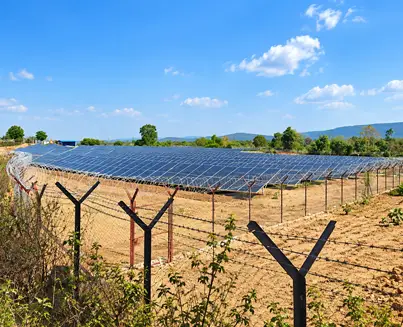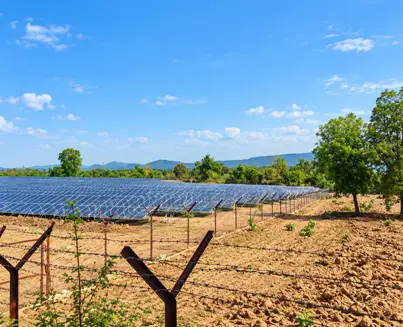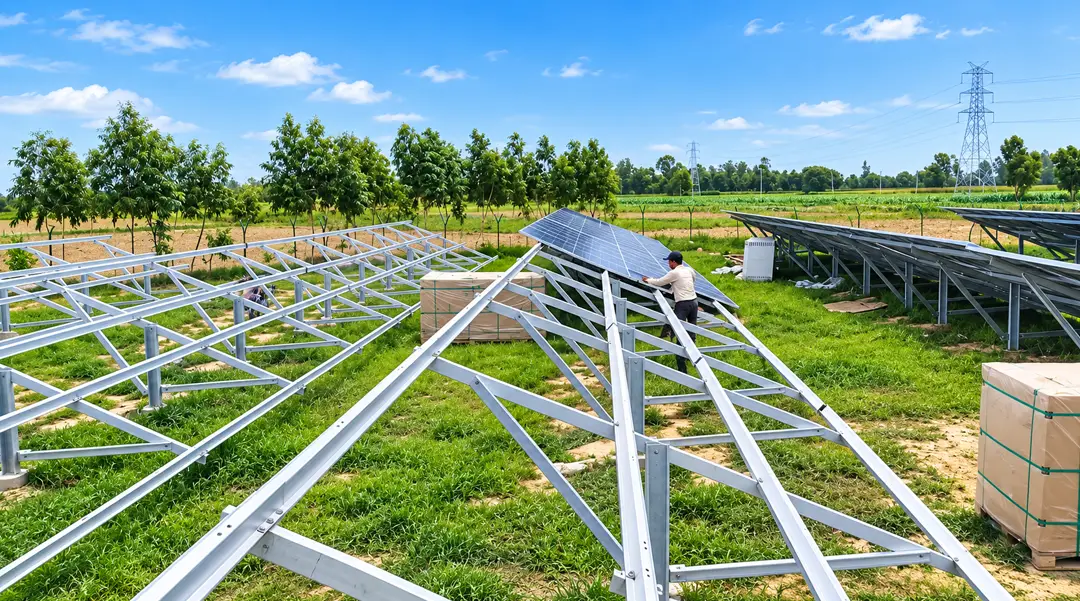
Somaya Solar Solutions Limited supports ground-mounted solar power plant projects for organizations and project owners planning solar installations on available land across India.
Unlike rooftop solar, a ground-mounted project places the solar array directly on land. This introduces a different set of execution considerations involving land condition, access, layout, mounting structures, civil interfaces, electrical routing, grid requirements, testing, commissioning and long-term maintenance access.
Somaya's supplied verified project records include ground-mounted plants of 2.4 MW and 1 MW, with recorded responsibilities covering supply, installation, testing and commissioning. The 1 MW project also includes five years of O&M.
What Is a Ground Mounted Solar Power Plant?
A ground-mounted solar power plant is a photovoltaic system installed on supporting structures anchored directly into the ground rather than onto a building roof.
Ground-mounted systems are commonly considered where:
- Sufficient open land is available
- Project capacity exceeds practical rooftop availability
- Project owners need flexibility in module orientation and layout
- Maintenance access is important
- A separate solar-generation site is planned
- A captive, institutional, agricultural, scheme-linked or larger generation project is being evaluated.
Project configuration depends on the purpose of the plant, available land, electrical requirement and grid arrangement.
A ground-mounted project is not automatically a utility-scale project. The physical installation type and the project's generation/grid model are separate considerations.
Ground-Mounted Solar Starts with the Site
The land itself can influence almost every subsequent engineering and execution decision.
Before final project design, relevant questions can include:
- How much usable land is available?
- Is the site level or sloping?
- Are there drainage issues?
- Is the land accessible for construction vehicles?
- Are there underground utilities or physical obstructions?
- What are the soil conditions?
- Is significant grading or site preparation required?
- Where can inverters, transformers and electrical equipment be located?
- How far is the proposed interconnection point?
- Is future maintenance access available?
These questions should be addressed during project-specific technical evaluation rather than assumed from capacity alone.
Ground-Mounted Solar Site Assessment and Feasibility
A ground-mounted solar feasibility study should establish whether the available land can practically support the proposed plant before detailed design and execution decisions are locked.
Depending on the project and site conditions, assessment may require land and access review, topographical information, drainage evaluation, preliminary layout considerations, grid-interface information and appropriate geotechnical investigation or soil testing.
A topographical survey can help establish levels, slopes, site boundaries, drainage conditions and layout constraints. Geotechnical investigation can provide inputs relevant to foundation and structural engineering.
The exact surveys and studies required, and Somaya’s responsibility for carrying them out or coordinating them, should be defined in the project scope.
Land Area Is Not the Only Ground-Mount Design Factor
Buyers often begin with one question:
How much land is required per MW?
A generic acres-per-MW figure can be useful only for early planning.
Actual land requirement can change according to:
- Module dimensions and wattage
- Fixed-tilt or tracking configuration
- Row spacing
- Shading requirements
- Ground coverage ratio
- Site shape
- Setbacks
- Internal roads
- Drainage
- Inverter / Transformer locations
- Terrain
- Electrical corridors
- Maintenance requirements.
The final land requirement should therefore come from the project layout rather than a universal website figure.
Why Topography and Soil Conditions Matter
Ground-mounted structures transfer wind and structural forces into the ground.
Site conditions can therefore influence the most suitable foundation and mounting approach.
Depending on the project and engineering requirement, evaluation may consider:
- topographic conditions
- soil bearing characteristics
- rock depth
- groundwater
- wind conditions
- drainage
- corrosion environment
- structural loads.
For larger ground-mounted projects, appropriate topographical and geotechnical inputs can become important where site conditions affect layout, drainage, foundation selection or structural engineering.
Somaya's exact responsibility for these studies should be defined in the project proposal rather than assumed.
Ground-Mounted Solar Foundation Options
Different sites can require different structural foundation approaches.
Common industry configurations include:
Driven / Rammed Piles
Steel posts may be driven or rammed into suitable ground conditions.
This can reduce concrete work on appropriate sites, but suitability depends on engineering and soil conditions.
Concrete Foundations
Concrete-based foundations may be considered where site or structural requirements make them appropriate.
Other Engineered Foundation Systems
Rocky, loose, uneven or otherwise difficult ground can require a different engineering approach.
The foundation method should be selected from actual project conditions rather than treated as a standard specification for every site.
Module Mounting Structures
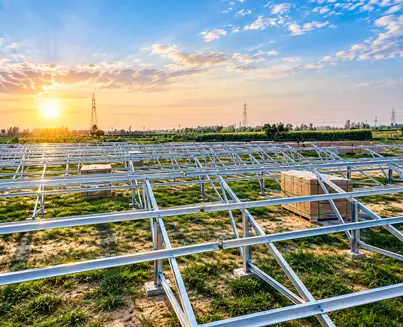
Module Mounting Structures, or MMS, support the solar modules at the required orientation and elevation.
Ground-mounted structure planning may need to account for:
- wind loads
- terrain
- module configuration
- corrosion exposure
- row geometry
- foundation interface
- access for cleaning and maintenance
- fixed or moving system configuration.
Structure specifications should follow the approved engineering for the individual project.
Fixed-Tilt vs Tracker-Based Ground-Mounted Solar
Two common industry configurations are fixed-tilt and solar tracking systems.
Fixed-Tilt Systems
Modules remain at a predetermined orientation.
They generally involve fewer moving components and can provide comparatively straightforward maintenance.
Tracker Systems
Tracker systems change module orientation during the day to follow the sun.
They can improve energy capture in appropriate projects but can also add:
- mechanical complexity
- land-layout considerations
- controls
- maintenance requirements
- different foundation loads
- additional capital cost.
The right configuration depends on project economics, land, irradiation, equipment strategy and engineering.
Tracker-based execution should be included in Somaya’s project scope only where the required system, engineering and responsibilities are specifically agreed for that project.
Ground-Mounted Solar Civil Works and Site Execution
Civil work for a ground-mounted solar plant depends on the approved layout, site condition, foundation design and contracted responsibility matrix.
Project-specific execution can involve site preparation, grading or levelling where required, foundation works, equipment bases, internal access provisions, drainage interfaces and trenches or routes for electrical cabling.
Trenching and cable routing should be coordinated with the plant layout, equipment locations, road crossings, drainage, safety requirements and the approved electrical design. DC and AC cable routes can therefore influence both civil execution and long-term maintenance access.
Not every site requires the same civil package. Final quantities, methods and Somaya’s responsibility for individual civil works should follow the approved engineering and project contract.
Ground-Mounted Solar Electrical Execution
Physical module installation is only one part of a complete plant.
A ground-mounted project may also involve project-specific electrical infrastructure such as:
- DC cabling
- inverter systems
- AC cabling
- earthing
- lightning protection
- switchgear
- transformers
- HT systems
- metering
- plant monitoring
- connection to the relevant electrical network.
The exact electrical package varies materially between projects.
Only items explicitly included in Somaya's approved technical and commercial proposal should be treated as contracted scope.
Grid Connection and Evacuation
Where generated power must interact with the electricity network, grid connectivity can become a critical project interface.
Relevant considerations may include:
- connection point
- voltage
- distance
- feeder availability
- metering
- protection
- transformer requirements
- utility / DISCOM process
- evacuation infrastructure
- testing and synchronization.
A ground-mounted project can therefore involve much more than installing modules and structures.
The party responsible for each grid-related activity should be identified clearly in the project scope. Where grid synchronisation forms part of the project, commissioning must be coordinated with the applicable protection, metering, testing, connection and utility requirements. The exact synchronisation and DISCOM responsibility should be confirmed for each project rather than assumed as a standard part of every ground-mounted installation contract.
Ground Mounted Solar Installation Scope
A ground-mounted solar EPC company or contractor may handle a defined combination of engineering, procurement, civil and structural works, mounting-system installation, electrical execution, testing and commissioning. The exact responsibility depends on the site, plant configuration and agreed EPC scope.
For buyers evaluating ground-mounted solar EPC or installation companies in India, the scope should be checked package by package rather than assuming that every contractor provides the same services.
Based on Somaya’s supplied ground-mounted project evidence, its verified responsibilities on the referenced projects include supply, installation, testing and commissioning, with five years of O&M additionally recorded for the 1 MW KRIBHCO Hazira project.
Supply
The project records include supply within Somaya's stated scope.
Installation
Ground-mounted installation is included in the verified project records referenced on this page.
Testing & Commissioning
Testing and commissioning are also explicitly recorded.
O&M
The supplied 1 MW KRIBHCO Hazira project includes five years of O&M within the recorded scope.
O&M inclusion for a new project should always be confirmed in the individual contract.
Ground-Mounted Project Evidence from Somaya
2.4 MW Ground-Mounted Project — Katni, Madhya Pradesh
Project: KUSUM-C, Ram Sati Devi
Capacity: 2.4 MW
Location: Katni, Madhya Pradesh
Project Type: Ground Mounted
Recorded Scope: Supply, Installation, Testing & Commissioning
The supplied record identifies a transmission-line-related challenge.
Somaya's recorded response was liaisoning with the local DISCOM.
The project demonstrates ground-mounted execution together with testing, commissioning and project-specific DISCOM liaison in response to a transmission-line-related execution challenge.
Recorded Status: Up and running.
2.4 MW Ground-Mounted Project — Amroha, Uttar Pradesh
Project: KUSUM-A, Bhavnath Singh
Capacity: 2.4 MW
Location: Amroha, Uttar Pradesh
Project Type: Ground Mounted
Recorded Scope: Supply, Installation, Testing & Commissioning
Site access was recorded as the primary execution challenge.
The supplied evidence states that local support was used to address access to the project location.
This provides a useful ground-mounted execution example because land availability alone does not guarantee easy project mobilisation.
Road access, material movement, manpower and construction logistics can materially affect execution.
Current Source Status: Work in Progress.
The status must be reconfirmed immediately before publication.
1 MW Ground-Mounted Project — KRIBHCO, Hazira
Industry: Fertilizer
Capacity: 1 MW
Location: Hazira, Gujarat
Project Type: Ground Mounted
Recorded Scope: Supply, Installation, Testing & Commissioning with Five Years O&M
The supplied record identifies completion timeline as a project challenge.
Recorded Status: Up and running.
This project provides first-party evidence not only of ground-mounted installation and commissioning, but also recorded post-commissioning O&M responsibility.
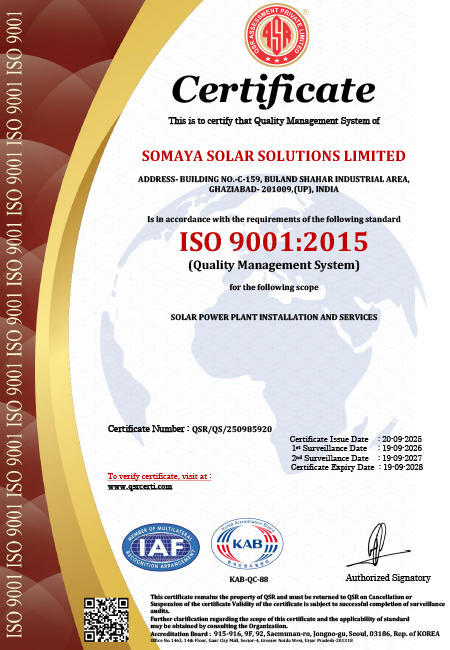
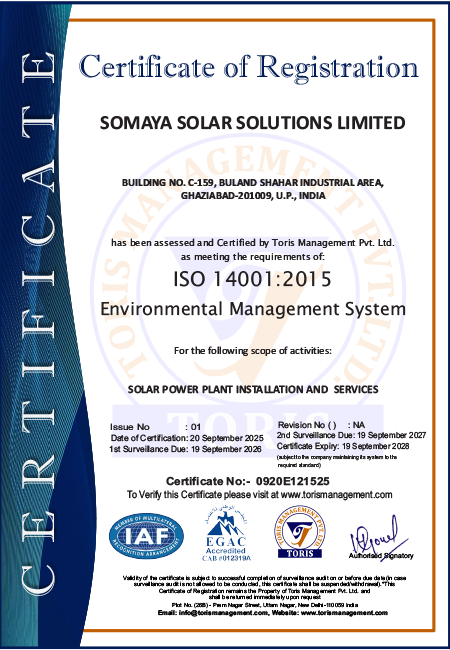
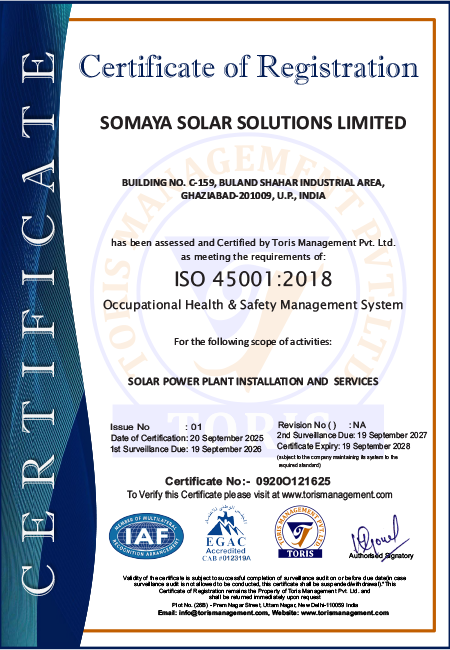
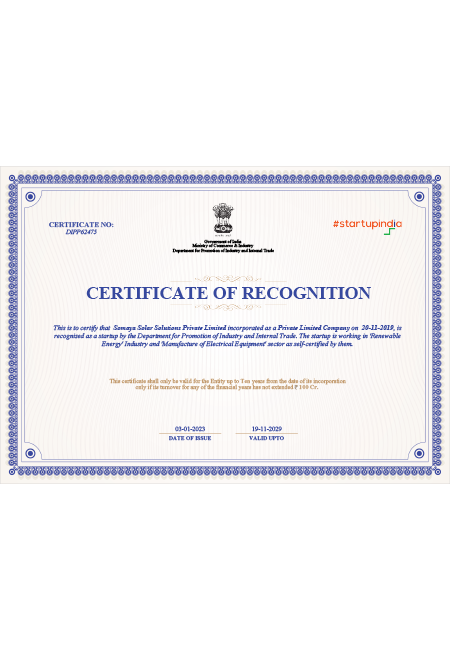
Review actual project capacities, locations, industries, photographs and available company certification or registration evidence rather than relying only on marketing statements.
Ground Mounted Solar vs Rooftop Solar
The main difference is not simply where the modules are placed.
Ground Mounted
Typically involves:
- open land
- independent mounting structures
- dedicated land layout
- ground/foundation considerations
- easier ground-level access
- greater capacity flexibility where land is available.
Rooftop
Typically involves:
- existing building roof
- roof structural limitations
- access/height constraints
- roof waterproofing and operational interfaces
- capacity restricted by usable roof area.
Factory and commercial rooftop requirements are covered separately under Somaya’s Commercial & Industrial Solar Installation service.
Ground Mounted Solar vs Utility Scale Solar
The two terms overlap, but they do not mean the same thing.
Ground mounted describes the physical installation configuration.
Utility scale describes the broader scale, generation purpose and grid/infrastructure context of a large centralized project.
A 1 MW or 2.4 MW plant can be ground mounted without automatically being classified as utility scale.
This distinction matters when comparing company portfolios.
Large centralized utility-project requirements are covered separately under Somaya’s Utility Scale Solar Power Plant Installation service.
Ground Mounted Solar vs Solar Farm
“Solar farm” is commonly used as a conversational term for a larger ground-mounted solar installation.
However, buyer intent can vary.
A solar farm may refer to:
- a captive plant
- an open-access generation project
- an IPP-owned plant
- a government/scheme project
- a utility-scale project.
The commercial model should therefore be confirmed separately from the physical ground-mounted configuration.
For buyers searching for a solar farm EPC contractor or solar farm installation company in India, the physical execution requirement can overlap substantially with a large ground-mounted solar project. Site assessment, foundations, mounting structures, civil and electrical works, grid interfaces, testing and commissioning may all form part of the required project scope.
The term “solar farm” does not by itself establish whether the project is captive, open access, IPP-owned, scheme-linked or utility scale. That commercial or regulatory model should be evaluated separately.
Ground Mounted Solar and PM-KUSUM Projects
Some PM-KUSUM projects use ground-mounted solar systems.
However, the terms should not be treated as interchangeable.
PM-KUSUM is a government scheme with scheme-specific rules, components, selection mechanisms, tariff/PPA structures and state implementation.
Scheme-specific requirements such as PM-KUSUM components, eligibility, tender or allocation structure and PPA conditions are covered separately under Somaya’s PM-KUSUM Solar Projects service. This ground-mounted service focuses on the physical, technical and execution requirements of plants installed on land.
Ground-Mounted Solar and Captive / Open-Access Models
Ground-mounted plants can operate under different commercial arrangements.
A project may serve onsite/captive demand or interact with a broader power-sale/open-access arrangement.
However, EPC or installation experience does not automatically prove that the contractor:
- finances the project
- owns the solar asset
- signs a PPA
- manages open-access commercial arrangements
- forms an SPV
- sells electricity.
These roles should be verified separately.
Investment, asset ownership, PPA and power-sale responsibilities are separate from ground-mounted EPC execution and should be evaluated under the applicable Solar IPP development model.
What Should Be Evaluated Before a Ground-Mounted Solar Project?
Site Suitability
Available land should be assessed for usable area, slope, access, drainage and obstructions.
Soil and Foundation Conditions
Foundation assumptions should match actual site conditions.
Plant Layout
Layout influences generation, land usage, cable lengths, roads and maintenance.
Structure Configuration
Fixed-tilt, seasonal or tracker-based structures involve different technical considerations.
Electrical Infrastructure
Inverters, transformers, cabling, protection and grid interfaces must align with plant configuration.
Project Access
Heavy material and equipment may need to reach remote or difficult sites.
Grid / DISCOM Interface
Where relevant, project responsibility for connectivity and liaison should be clearly defined.
Commissioning
Testing and acceptance requirements should be agreed before execution.
O&M Access
Future cleaning, inspection, vegetation management and equipment access should be considered during planning.
How to Compare Ground Mounted Solar EPC or Installation Companies
Do not compare providers only on a headline per-MW or per-kW price.
Evaluate:
Relevant Ground-Mounted Project Evidence
Request actual project names, capacities, location and recorded scope.
Site-Specific Execution Experience
Ask how the contractor has handled access, grid interfaces, terrain or other actual project constraints.
Scope Clarity
Confirm responsibility for:
- equipment supply
- structures
- foundations
- civil activities
- installation
- electrical works
- grid interface
- testing
- commissioning
- O&M.
Engineering Responsibility
Do not assume every contractor performs every survey or engineering activity internally.
Confirm the actual responsibility matrix.
Project Status
Ask whether showcased projects are completed, commissioned, operational or still under execution.
Supporting Evidence
Photographs, work documents, commissioning evidence and project-specific technical records are stronger than generic marketing language.
What Affects Ground Mounted Solar Project Cost?
There is no universal reliable price per MW.
Important variables can include:
- capacity
- land condition
- site preparation
- soil/foundation requirements
- mounting structure
- module selection
- fixed-tilt or tracker configuration
- inverter architecture
- DC/AC systems
- transformers
- electrical infrastructure
- evacuation/grid requirements
- access roads
- drainage
- project logistics
- commissioning
- O&M scope.
A defined site and technical scope are required for a meaningful commercial proposal.
What Affects the Project Timeline?
A ground-mounted project timeline can depend on:
- land readiness
- access
- engineering inputs
- equipment procurement
- foundation work
- civil activities
- structure installation
- module installation
- electrical work
- grid-related interfaces
- testing
- commissioning.
The Amroha project evidence itself shows why site accessibility can become a real execution issue.
For this reason, a project-specific schedule is more credible than a universal installation-time promise.
Operations & Maintenance for Ground-Mounted Plants
Ground-level access can make some inspection and cleaning activities more accessible than high rooftop work, but larger plants also create their own maintenance requirements.
Depending on plant design and contracted scope, O&M planning may involve:
- module cleaning
- vegetation control
- structure inspection
- electrical inspection
- inverter maintenance
- transformer/equipment checks
- fault response
- performance monitoring
- access-road upkeep.
Somaya's verified KRIBHCO Hazira record includes five years of O&M.
Specific activities and service levels should be defined in the individual O&M agreement.
Ground Mounted Solar Power Plants Across India
Somaya Solar Solutions Limited operates from Ghaziabad, Delhi NCR, with strong relevance in Uttar Pradesh.
Its verified ground-mounted project records referenced on this page include work in Madhya Pradesh and Gujarat.
Project opportunities elsewhere in India can be evaluated according to capacity, site location, project scope, mobilisation requirements and execution feasibility.
India-wide service language should not be interpreted as an office or branch in every state.
What Information Is Needed for a Ground-Mounted Solar EPC Proposal or RFQ?
For a ground-mounted solar EPC proposal, RFQ or applicable tender discussion, the contractor needs enough information to understand the site, capacity, project stage, electrical interface and required responsibility matrix.
Where an RFQ or tender document already exists, its technical specifications, scope, commercial conditions and submission requirements should take precedence over generic assumptions.
Useful starting information includes:
- project location
- proposed plant capacity
- available land
- land dimensions
- current land status
- basic terrain information
- site access details
- project purpose
- expected project model
- electricity / generation requirement
- known grid or DISCOM information
- project stage
- required supply / installation / commissioning scope
- O&M requirement
- RFQ / tender documents where applicable
- available land drawings or survey records.
Providing this information helps make the initial discussion more project-specific.
Frequently Asked Questions
What is a ground-mounted solar power plant?
It is a solar photovoltaic plant where modules are installed on supporting structures anchored on land rather than a building roof.
How much land does a ground-mounted solar plant need?
There is no single land figure applicable to every project. Capacity, module selection, row spacing, fixed-tilt/tracker arrangement, setbacks, roads, terrain and electrical infrastructure all influence usable land requirement.
Is soil testing required for every ground-mounted project?
The required level of geotechnical assessment depends on site and engineering needs.
For larger projects, soil conditions can materially affect foundation selection and structural design, so appropriate site investigation may be necessary.
Which foundation is best for ground-mounted solar?
There is no universally best foundation.
Driven/rammed piles, concrete foundations and other engineered systems can be suitable under different soil and structural conditions.
Is fixed tilt better than a solar tracker?
It depends on the project.
Trackers may improve energy capture but introduce additional mechanical, maintenance and cost considerations. Fixed-tilt systems are mechanically simpler.
The decision should be project-specific.
Is every ground-mounted plant a utility-scale plant?
No.
Ground mounted describes installation configuration utility scale describes the broader generation and grid context.
Can ground-mounted solar be used for industrial captive power?
Yes, ground-mounted solar can be physically configured for industrial/captive applications where land and electrical arrangements support the project.
The commercial and regulatory model must be evaluated separately.
Does ground-mounted solar require a grid connection?
Not every project has the same electrical arrangement.
Where the plant is grid connected, the required connection, metering, protection and utility process depend on project configuration.
Does Somaya have MW-scale ground-mounted project experience?
Somaya's currently verified evidence referenced on this page includes a 2.4 MW ground-mounted project and a 1 MW ground-mounted project.
What is Somaya's verified ground-mounted scope?
The verified project records referenced on this page show supply, installation, testing and commissioning. The 1 MW KRIBHCO Hazira record additionally includes five years of O&M.